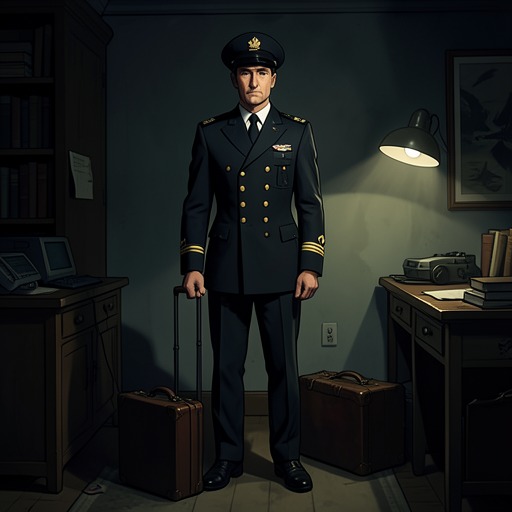
Caine's General Drills Gear and Collective Leave-Penalty Incident
The Caine MutinyPhilip Francis Queeg’s general-drills gear and collective leave-penalty incident aboard the USS Caine turns a routine readiness exercise into a revealing contest over authority. A request for helmets and life jackets becomes a trap: the sailors find a practical way to equip everyone, but Queeg treats their solution as further disobedience and ultimately imposes punishment on the whole crew. The episode establishes how, under his command, compliance can be demanded as a performance while the crew’s own workable response is rejected.
The drill and its immediate context
The incident occurs while the USS Caine is escorting a convoy between Hawaii and San Francisco. The ship is part of a screen protecting fleet oilers, transports, and merchant vessels. For Willie Keith, serving as junior officer of the deck, the voyage has offered the possibility—however remote—of taking the conn and encountering an enemy submarine. The war feels newly immediate to him, although the ship is then conducting a general drill in peaceful waters.
Philip Francis Queeg arrives on the bridge shortly before two o’clock with Burt Gorton following him. Gorton has just been reprimanded for not conducting general drills often enough and is preparing to explain the omission in a written report. Queeg’s concern is connected to a CincPac letter requiring ships to report how many drills they conduct each month. He orders the signalman to announce that a drill is under way. At Queeg’s nod, Willie pulls the red general-alarm handle in the wheelhouse, and the ship’s crew is summoned to battle stations.
The officers on the bridge appear properly equipped, but many sailors arrive without a helmet, a life jacket, or both. Their incomplete gear is the specific failing Queeg chooses to address. He orders Tom Keefer to announce that a man without one item will lose a day of leave in the United States, while a man wearing neither will lose three days. The names of those sailors are to be reported to the bridge at once. In this way, a training exercise intended to test readiness becomes a system for identifying and penalizing individual crew members.
The order becomes a disciplinary crisis
Tom Keefer objects that the punishment seems harsh, but Queeg refuses to hear an opinion on measures he considers necessary for instruction and safety. Keefer makes the announcement. The sailors at the gun stations look toward the bridge in disbelief and anger; then helmets and life jackets begin moving from hand to hand. Their response is direct: instead of waiting for individual penalties, they redistribute the available gear so that everyone can appear equipped.
Queeg immediately rejects this solution. He demands that the transfer stop and that the names be reported before anyone puts on a helmet or jacket. When the movement of gear continues, he orders Keefer to have the sailors responsible arrested. Keefer relays the arrest order to Chief Bellison, and the flow of equipment halts. By then, however, spare gear is available around the deckhouses, and the men rapidly finish dressing for the drill. The practical aim of the order—having the crew protected at general quarters—has been met, but the bridge remains focused on the failure to identify and punish the original offenders.
Queeg moves about the bridge trying to identify men who are still putting on equipment and calls for one sailor to be reported after noticing his helmet. The effort to single out offenders does not produce the names he wants. By the time he addresses the crew over the loudspeaker, every man aboard is wearing a helmet and life jacket, yet Queeg presents the outcome as a coordinated attempt to deceive him. Since the names are not forthcoming, he deprives every sailor of three days’ leave. His stated reasoning makes the innocent share the penalty and expects the crew to punish those he considers responsible themselves. The incident therefore ends with universal compliance in the visible matter of protective gear, but collective punishment for the crew’s refusal—or inability—to supply a list of names.
A pattern of command and compliance
The episode’s central reversal is that the sailors’ improvised response achieves the safety result Queeg invoked, while the captain treats that same response as an affront to his authority. His demand changes from equipping the crew to stopping the movement of gear until responsibility can be assigned. The final collective penalty is not a further measure of readiness; it asserts that Queeg can define the meaning of obedience and impose consequences when his preferred procedure fails.
Later descriptions of life aboard the USS Caine place the episode within a broader pattern. Queeg posts strict orders, cancels liberty over a cigarette butt, and enforces new rules most visibly within the areas he can see and hear. The crew adapts by observing those rules in his immediate presence while ordinary shipboard habits continue elsewhere. That later pattern gives the drill scene additional significance: the sailors’ quick exchange of helmets and life jackets is a collective, practical workaround, while Queeg’s response reinforces a command culture in which the appearance of exact obedience matters alongside—or in place of—the task’s purpose.
The episode also marks Willie’s early exposure to the difference between formal military routine and the lived experience of service. He has imagined the possibility of wartime glory; instead, he witnesses an exercise shaped by reports, punishment, and the strained relations between captain and crew. The convoy later encounters rough seas, and the voyage’s watches and work become physically wearing. Against that larger passage, the general-drills confrontation is not a combat encounter but an early demonstration of the USS Caine’s internal pressures. The novel’s prefatory note identifies the ship, its people, and the events aboard it as fictional, and cautions that operational details have been altered; the episode functions within that fictional account as a study of command and discipline rather than a record of an actual naval incident.